The orders, day by day
The cake is written down with its day and its deposit, and every morning out comes the list of what has to be made.
Quick sales over the counter, weight for the pastries and orders written down with their date.
The POS opens straight away, with no username and no password.
How a sale is made
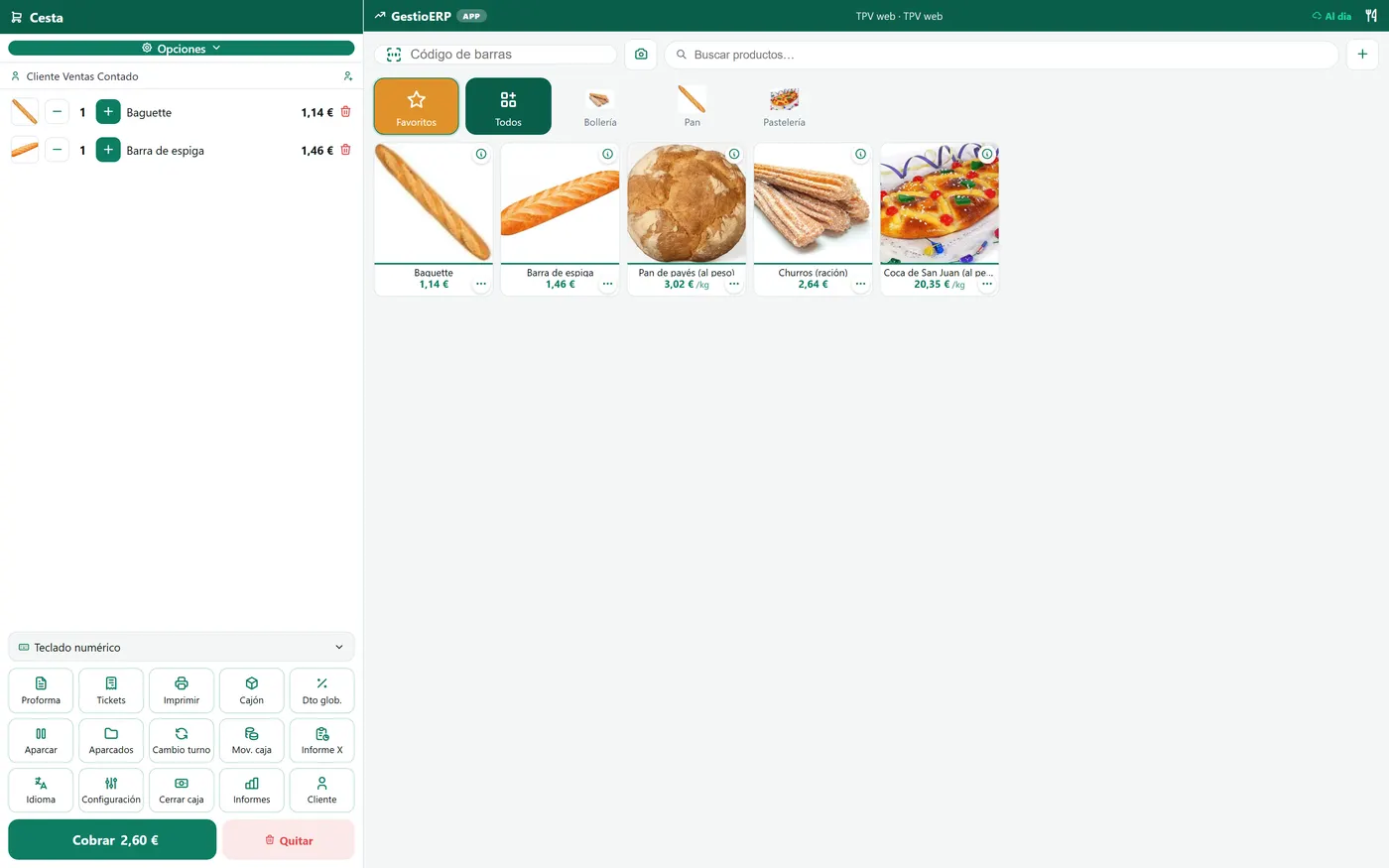
You tap, you take the payment and the receipt comes out. This is the real screen from the demo.
In service
The bill fills up on the left and, on the right, you see what happens in this trade and in no other.
Nobody touches the cash
You serve it and weigh itThe customer pays at the machineThe machine counts and gives the changeThe hands on the bread never touch the money
A bakery sells a lot, cheaply: three loaves, two croissants and an ensaimada, and next please. Here anything that isn't touching the product and taking the money is in the way.
The day's items come up on the first screen, with their photo, one tap away. What is sold by weight goes through the scale, and what is sold by the unit, through the keypad. And the next morning you can see what went out and what was left.
Orders —Saturday's cake, Monday's fifty muffins— are written down with their day and their deposit, and come up on the list on the right morning.
Made for this trade
The cake is written down with its day and its deposit, and every morning out comes the list of what has to be made.
Pastries by weight on the scale; loaves, one tap. Every item knows how it is sold.
What was sold and at what time, so you know how much to make tomorrow and stop throwing food away.
What goes to the bar next door or to the other shop, written down and invoiced at the end of the month.
The counter
The scanner you already have, by USB or wireless. Scan the barcode and the item drops into the line with its price; and if you haven't got one, the phone camera reads it too.
You put the goods on the plate, tap the item and the weight is already on the line with its amount. It also reads the labels the counter scale prints, with the weight inside.
Hygiene and cash control
It works with the drawers that take the money and give the change back —the Cashlogy ones by Azkoyen and other makes—. The POS tells it the amount, the customer drops in the notes and the coins, and the machine counts the change out. Nobody touches the cash.
Notes and coins go from hand to hand all day long, and since covid no customer wants to see the same hand that took their money handing them the bread. With the drawer, the customer puts the money into the machine and the machine gives the change back: the assistant never touches the cash, doesn't take the gloves off or wash their hands every five minutes, and goes back to the food clean.
It is a real demo business, with its own catalogue and its own sales. No sign-up needed.