Size and colour, properly
One garment with its variants. The stock comes off the size that was sold, not off the garment.
Sizes and colours without inventing product codes: one garment, its variants and the stock of each one.
The POS opens straight away, with no username and no password.
How a sale is made
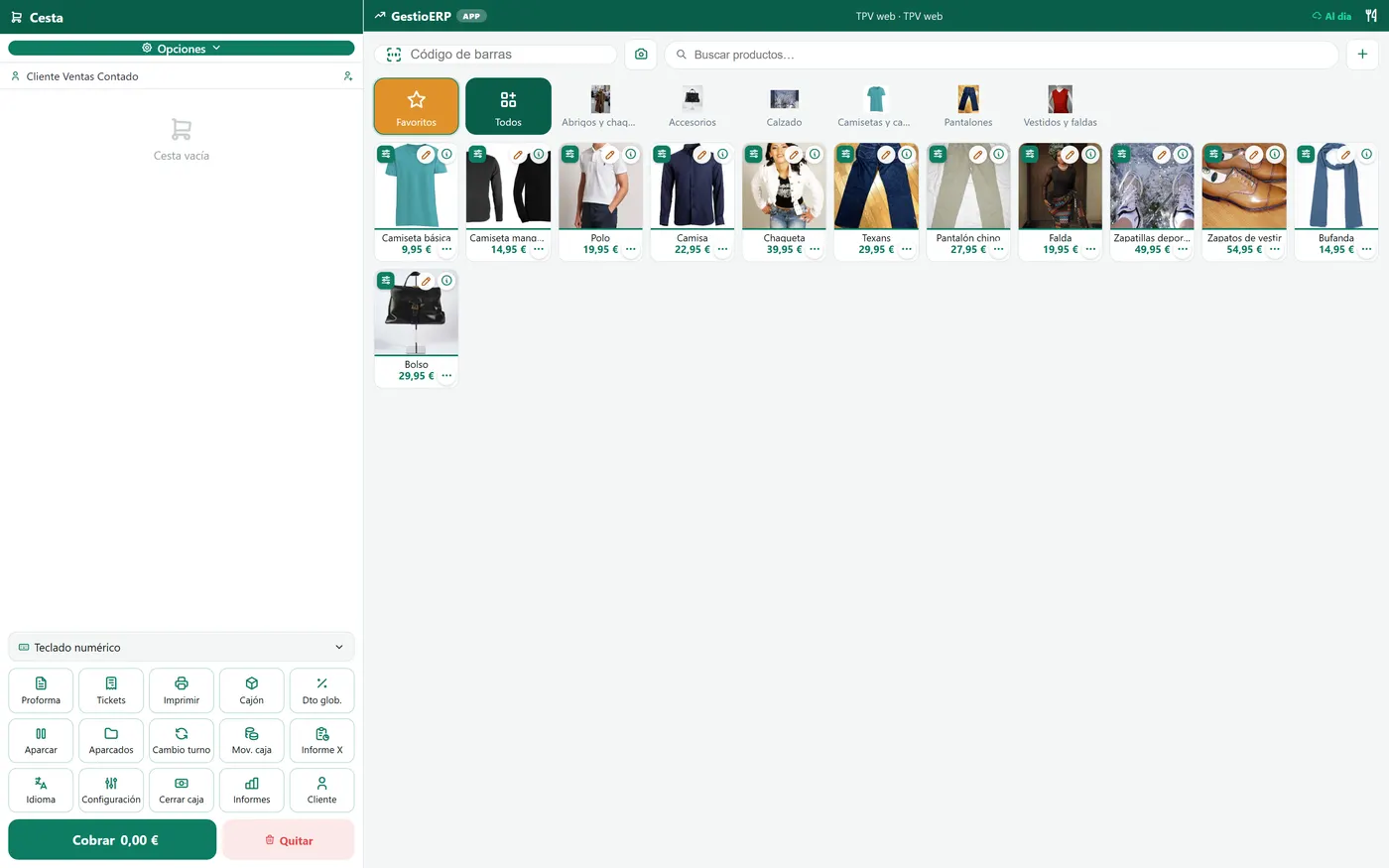
You tap, you take the payment and the receipt comes out. This is the real screen from the demo.
In service
The bill fills up on the left and, on the right, you see what happens in this trade and in no other.
Size and colour
Every garment, with its size and colourThe same model, four sizesYou take the payment and the receipt comes outAnd with the receipt, it is exchanged without arguing
The problem in a clothes shop isn't selling, it is knowing what is left. The same shirt in five sizes and three colours is fifteen different things, and keeping track of it with made-up codes always ends the same way: selling what you haven't got.
Here the shirt is one garment with its sizes and its colours. Tap the garment, choose the size and that's it: the stock comes off that variant and no other. What needs restocking can be seen at a glance, by size, and nobody has to count hangers.
And everything else that happens in a shop every day: the change of size, the return with a receipt, the credit note for the next visit and the sales by family or by season.
Made for this trade
One garment with its variants. The stock comes off the size that was sold, not off the garment.
You look up the receipt, change the size and that's it. And if it comes to it, a credit note for the next visit.
They are printed from the same program, with the code for each size and its price.
The same stock as the counter: if the last one is sold in the shop, it comes off the website.
It is a real demo business, with its own catalogue and its own sales. No sign-up needed.